Garage Workbench With Drawers vs Cabinets
For a garage workbench with drawers, pick the MUWOOD if you want an adjustable height and outlets, and pick the Hak if you want a locking cabinet. Both benches have drawers, so locking storage, height and floor room decide the choice.
On this page (15 sections)
- What belongs in drawers, and what belongs in a cabinet?
- Which bench handles small parts better?
- Which bench locks up tools and chemicals?
- Which top gives you more working room?
- Which bench is built tougher, rubberwood or all steel?
- How do the two pegboards compare?
- Which bench is better for power tools and lighting?
- Which bench works better for sitting and standing?
- How much floor space does each bench take?
- How much weight can each bench carry?
- How easy is each bench to set up?
- The specs side by side
- Who should pick which bench
- Which drawer details should you confirm before you order?
- Which garage workbench with drawers should you pick?
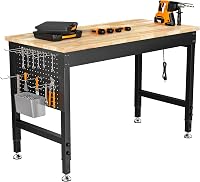
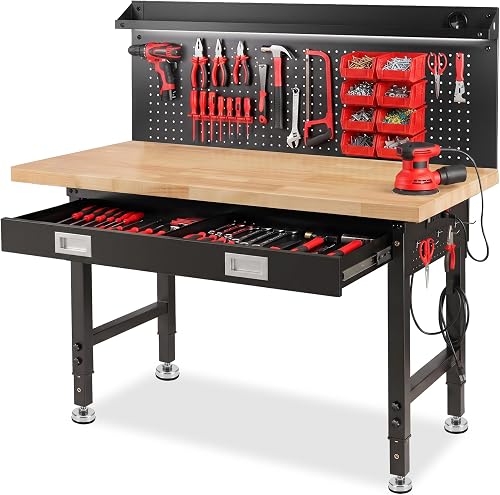
If you want a garage workbench with drawers, the choice comes down to drawers and a pegboard, or drawers plus a lockable cabinet. The MUWOOD is a 60 in bench with drawers, a pegboard and a strip light, and the Hak is a 48 in steel bench with two drawers, a lockable cabinet and a pegboard.
Both have drawers, so the real difference is what comes with them: a height you can change and four outlets on the MUWOOD, or a locking cabinet on the Hak. For the full category, start with our garage workbenches buying guide.
 Best for a bench you can raise and lower
MUWOOD 60 in Workbench With Drawers and Strip Light
 Best for a locked cabinet and tool storage
Hak 48 in Workbench With Drawers and Lockable Cabinet
What belongs in drawers, and what belongs in a cabinet?
Drawers suit small things you grab all day, and a cabinet suits bulky or hazardous things you want shut away. The split is easy once you picture your own tools.
- Drawers: screws, nuts, drill bits, tape, utility knives and other small parts you reach for daily
- Cabinet: spray cans, solvents, cleaners, larger power tools and anything you'd rather keep behind a door
- Pegboard: hand tools you use every few minutes, hung where you can see them
Follow the label on any chemical for storage directions, and keep lids tight. A lock adds control, but it doesn't replace the label.
Which bench handles small parts better?
The Hak has the clearer small-parts storage, with two deep drawers that Hak made for screws, nuts and utility knives. The MUWOOD has drawers too, but MUWOOD doesn't say how many or how large they are.
What the MUWOOD adds is a pegboard section made to hang small parts boxes, so you can see what's in each one. A drawer keeps parts out of sight, while a box on a pegboard keeps them at eye level.
If a pegboard is your main reason to buy, our best workbenches with pegboard roundup has more benches to compare.
Which bench locks up tools and chemicals?
The Hak does, and the MUWOOD doesn't. Hak's main cabinet has a pry-proof locking device, and Hak says the cabinet is there to keep chemicals and valuable tools secure.
Hak also says the doors close on magnets and open with one hand. The MUWOOD has drawers and a pegboard but no locking cabinet, so anything you want locked away needs a separate box.
A lock matters most in a garage that roommates, relatives or visitors use. If you're weighing a locked box against an open bench, our mobile workbench vs tool chest comparison lays out the trade.
Which top gives you more working room?
The MUWOOD does, with a 60 x 22 in top against the Hak's 47 x 23.6 in. The MUWOOD's top is solid rubberwood that's 1.2 in thick, and the Hak's steel top carries a thick rubber mat to protect tools.
The Hak's top is 1.6 in deeper, and it adds a 6 in extension table that Hak describes as extra workspace. Long boards favor the MUWOOD, so measure the longest piece you lay on the bench before you decide.
The MUWOOD's open legs also leave room under the top for a stool or a rolling bin. The Hak's pedestal base may use that space for storage instead.
Which bench is built tougher, rubberwood or all steel?
Neither wins on paper, because the two use different materials for different strengths. The MUWOOD pairs a 1.2 in solid rubberwood top with a 1.3 mm metal frame and extra support rods, and the Hak is all steel with a powder coat finish.
Wood is kinder to dropped tools and finished workpieces. Hak says its powder coat wipes clean, and steel lets magnets hold, which is why the Hak's LED strip can sit anywhere on the bench.
For a longer look at the trade, see our steel vs wood workbench comparison.
How do the two pegboards compare?
The Hak spreads its pegboard over three sides, and the MUWOOD puts one large board on the bench. Hak says its board holds 50 or more tools.
The MUWOOD's board has a section made for hanging boxes, plus extra rows beside the outlets so the board clears them. Neither maker states how many hooks come with the bench, so plan to buy a hook set.
A pegboard holds only what fits on a hook, so drawers still matter for small parts. Keep the heaviest tools on the bench top or in a cabinet.
Which bench is better for power tools and lighting?
The MUWOOD is, because it has four AC outlets and two USB ports built in, and the Hak doesn't mention outlets. The MUWOOD also comes with a strip light, and MUWOOD says its outlets are ETL certified.
The Hak's light is a magnetic LED strip with a color temperature from 3000K to 6000K and adjustable brightness. It sticks to the steel surface, so you can move it along the bench as the work changes.
Follow the maker's manual for the outlets, and ask a licensed electrician about the circuit before you run several tools at once.
Which bench works better for sitting and standing?
The MUWOOD does, because it adjusts from 28 to 40 in in six levels and needs no extra tools. Hak gives a 65 in overall height and describes no height adjustment.
The 65 in is the height of the whole unit, and Hak doesn't give a separate worktop height, so confirm it before you plan to stand at the Hak. The Hak also has a pedestal base, while the MUWOOD stands on open legs, so sitting at the Hak may leave less knee room.
Six levels means set steps rather than a smooth range, so check that one lands near your elbow height or your stool height.
Set the top so your forearms rest level when you work. If you have ongoing back, neck or shoulder pain, talk with a doctor before you change how you work.
How much floor space does each bench take?
The MUWOOD takes 13 in more wall, at 60 in wide against 47 in for the Hak. Depth is close, at 22 in and 23.6 in, so length is the real difference.
Leave room in front to pull each drawer all the way out, and room beside the Hak for its cabinet door to swing open. Measure the wall run and the path from your garage door before delivery.
How much weight can each bench carry?
The Hak has the higher rating, at 2,500 lb, against more than 2,000 lb for the MUWOOD. Both are the makers' ratings, and both assume weight spread evenly across the top.
A heavy vise or a stack of parts in one corner is a different case, and an uneven floor can rock a loaded bench. Treat each number as a rating, not a promise for every load.
Our guide on how much weight a workbench can hold explains why spread and floor matter.
How easy is each bench to set up?
Both are straightforward but heavy, at 105.1 lb for the MUWOOD and 100 lb for the Hak, so plan on a helper for the lifts. Each comes with instructions and pre-drilled parts.
MUWOOD advises you to leave the screws loose until the whole bench is together, then tighten them. Hak numbers each panel to match the steps, includes installation tools and points to an assembly video.
Both benches arrive heavy and bulky, so check the boxes on delivery and count the hardware before you build.
The specs side by side
The MUWOOD is the longer, adjustable bench, and the Hak is the higher-rated one with the lock. The table shows the three numbers that shape most of the choice.
| Product | Best for | Size | Height | Rated load | Our score |
|---|---|---|---|---|---|
| MUWOOD 60 in Workbench With Drawers and Strip Light | a bench you can raise and lower | 60 x 22 in | 28 to 40 in, adjustable | Over 2,000 lb (maker's rating) | 8.4 |
| Hak 48 in Workbench With Drawers and Lockable Cabinet | a locked cabinet and tool storage | 47 x 23.6 in | 65 in overall | 2,500 lb (maker's rating) | 8.1 |
We compared the specs and features of both benches. Our score weighs specs and features against what you're shopping for, which puts the MUWOOD at 8.4 and the Hak at 8.1.
The MUWOOD edges ahead for its height range, outlets and longer top. The Hak loses a little because it doesn't give a worktop height or describe any outlets.
Who should pick which bench
Pick the MUWOOD if you want drawers, a height you can change and power at the bench. Pick the Hak if you want a locked cabinet and the higher 2,500 lb rating.
Four common garages show how that plays out:
- Hobby work at a seat: the MUWOOD, because it lowers to 28 in and has outlets for a lamp and a charger
- Spray cans and solvents: the Hak, because its cabinet locks and keeps them off the bench
- Long boards and sheet goods: the MUWOOD, because its top is 60 in long
- A short wall run: the Hak, because it is 13 in narrower and keeps its storage in one steel unit
Skip the MUWOOD if a lock matters most, since nothing on it locks. Skip the Hak if you want to sit at the bench for long stretches or need outlets built in.
Which drawer details should you confirm before you order?
Confirm the drawer count and size on the MUWOOD, because MUWOOD states neither. The count changes how many kinds of small parts you can sort, and the size decides whether a tray or bin fits.
On the Hak, confirm the cabinet's inside size and shelf layout, since Hak gives neither. Neither maker states a warranty length, so ask for the terms before you order.
If you'd rather roll the bench out of the way, a mobile workbench with drawers may suit you better than a 100 lb bench.
Checking the drawers on a garage workbench
Before you set either bench in its spot, pull each drawer all the way out and confirm it clears the wall, a vise handle and any hooks. A drawer that catches every day gets old fast.
On the Hak, open the cabinet door fully too. Both benches are heavy once loaded, so settle the spot before you fill them.
Run through this list before you order:
- Measure the wall run, and the height of anything mounted above the bench
- Measure the garage door and any tight turns the boxes must pass
- Decide whether you need a lock, and whether you need outlets at the bench
- Check how far the spot sits from the nearest wall outlet
- Write down the drawer and cabinet sizes your parts and tools need
Which garage workbench with drawers should you pick?
Pick by what you store. If hand tools and small parts fill most of your bench, pick the MUWOOD for its height range and outlets, and if chemicals and valuable tools need a lock, pick the Hak.
If you're torn, list the three things you store most and measure your wall run. If you want a 48 in bench with a pegboard instead, our CAMMOO 48-inch review covers one.
For more options in each group, see our best garage workbenches with storage roundup.
Frequently asked questions
Is a garage workbench with drawers better than one with a cabinet?
Neither is better for every garage: drawers suit small parts you reach for daily, while a locking cabinet suits chemicals and valuable tools you want shut away. The Hak has both, so pick it if you need a lock, and pick the MUWOOD if height and built-in outlets matter more.
Do drawers or a cabinet hold small parts better?
Drawers hold small parts better, because they keep screws, nuts and bits in separate, shallow spaces you can find fast, while a cabinet suits bulkier items and keeps them shut away. Hak designed its two deep drawers for screws, nuts and utility knives, and its cabinet for larger tools and chemicals.
Is a lock on a workbench cabinet enough to keep tools safe?
A lock stops casual access but isn't a safe, and Hak says its cabinet has a pry-proof locking device, which is a good start for chemicals and valuable tools. Check the lock and the door fit when the bench arrives, and store anything you can't afford to lose somewhere more secure.
How much room does a 48 in or 60 in garage workbench need?
The 60 in MUWOOD needs a 60 in wall run, and the Hak needs about 47 in, with depth close at 22 in and 23.6 in. Leave extra space in front to pull a drawer or swing a cabinet door open, and measure the wall and the path from your garage door before delivery.