How to Attach Pegboard to a Workbench
You attach pegboard to a workbench by fixing it to the wall behind the bench or to the bench frame, with spacers or a furring strip so the hooks have room behind the board. Or skip the work and buy a workbench that already has a pegboard mounted.
On this page (10 sections)
- Should you mount pegboard on the wall, the bench frame or buy it built in?
- How much space do you need behind pegboard?
- Which pegboard panels fit your bench width?
- How do you attach pegboard to a wall step by step?
- Which screws and anchors suit which surface?
- How much weight can pegboard hold?
- Is a bench with pegboard built in easier?
- Which hooks fit once the board is up?
- What should you check once the board is up?
- Decide how to attach pegboard to a workbench
Here is how to attach pegboard to a workbench: choose where it mounts, leave room behind it for the hook ends, then fasten it with hardware that suits what's behind it. If you'd rather skip the work, a bench with pegboard built in does it for you.
This page is general guidance, not a plan for your wall or bench. Follow your bench maker's manual and the instructions that come with your anchors, and ask a pro if you aren't sure what's inside the wall.
Our garage workbenches buying guide covers bench types, so this page stays with the board. We checked the panel sizes and mounting notes for each product below.
Should you mount pegboard on the wall, the bench frame or buy it built in?
Mount it on the wall if the bench stays put, on the frame if the board has to move with the bench, and buy it built in if you're picking a bench anyway. Each route trades effort for flexibility:
| Route | Best when | Watch out for |
|---|---|---|
| Wall behind the bench | The bench stays against the same wall | The board stays behind if you move the bench |
| Bench frame | You pull the bench away from the wall | Check the bench manual before you drill into the frame |
| Built-in pegboard | You're buying a bench anyway | The hole size may not match the hooks you own |
Whichever you pick, keep the board level and flat, since a tilted board hangs every tool at a slant.
How much space do you need behind pegboard?
You need enough room for the hook ends, which means the board has to sit off the wall. Hooks slide in from the front and their ends poke out the back, so a board fixed flush has nowhere for them to go.
Spacers or a furring strip behind the board solve this. Hang one hook before you fasten the rest, and if it won't seat, the gap is too small.
Spampur and Daanxw don't say how far their panels stand off the wall, so the one-hook test matters most with those kits.
Which pegboard panels fit your bench width?
Pick the panel layout first, so the board covers the width you want before you drill a single hole. Spampur's set has four 16 x 12 in panels, and they join into a 64 x 12 in strip or a 32 x 24 in block.
Daanxw's panels are 12 x 12 in, and six of them make a 72 x 12 in strip or a 36 x 24 in block. Both brands use 1/4 in holes and say their panels take standard 1/8 in and 1/4 in hooks with 1 in spacing.
Do the math for your bench: a 48 in bench back takes three Spampur panels or four Daanxw panels in one row. Lay the panels out on the floor first and check that the holes line up across each seam.
Spampur recommends its panels for a wood wall and rates each small panel for up to 50 lb. Daanxw's kit adds installation hardware, cups, boxes and hooks to the panels.
How do you attach pegboard to a wall step by step?
Plan the layout, set the spacers, then fasten each panel level and tight. Go in this order:
- Mark a level line for the top row on the wall.
- Lay the panels against the wall in your chosen layout and check the gaps.
- Set spacers or a furring strip behind each panel so the hooks have room.
- Mark the screw points through the panel holes, then drill pilot holes for your fasteners.
- Fix each panel with a screw and washer at every mounting point, and check that it sits flat and tight.
- Hang one light tool to see how the hook seats before you add heavier ones.
Spampur and Daanxw both include screw and expansion pipe kits, and say a drill and a hammer are enough. Read the kit's instructions for the wall type before you drill.
How to attach pegboard to a workbench frame
When the board mounts to the frame, the fasteners go into the frame, so match them to what the frame is made of. Check the bench manual first, since some makers don't want extra holes drilled in the frame.
Spacers go between the board and the frame, so the hook ends have room behind the board. Check the corners with a square before you drill, so the board sits square to the bench.
Which screws and anchors suit which surface?
Match the fastener to what's behind the board, and use a washer under each screw head so it doesn't pull through. Buy anchors for the wall you have:
- Wood stud or solid wood frame: wood screws with washers, long enough to bite into solid wood.
- Masonry or concrete: anchors made for those surfaces, in the drill size the package calls for.
- Hollow wall: hollow-wall anchors made for the job, not plain screws in wallboard alone.
- Metal bench frame: fasteners that suit the metal, as the bench maker's manual describes.
If you aren't sure what you're looking at, ask a hardware store or a pro before you drill.
How much weight can pegboard hold?
Spampur rates each small panel for up to 50 lb, and that's the maker's figure, not a promise for every use. A rating assumes the panel is fixed well and the load is spread out, so don't hang a full load from one corner.
The hook has its own limit too, and a hook can't carry more than its own rating. Keep the heaviest tools low and near the bench, and follow the maker's manual for the bench and any wall fixings.
Is a bench with pegboard built in easier?
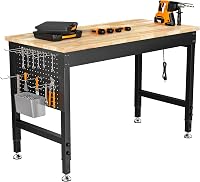
Yes, because it skips the mounting step, though you still need to plan the layout for your tools. CAMMOO's 60 in bench has a top pegboard and a pegboard on each side of its H-shaped frame, and CAMMOO says its pegboards need no drilling.
CAMMOO says the top board can mount to the table or a wall, and a magnetic LED light attaches to it. The bench is 60 x 22 x 39 in and adjusts in 6 height levels from 28.8 to 39 in.
CAMMOO doesn't give the hole size of its pegboards, so check it against your hooks before you order accessories.
If you're still deciding whether to build or buy, build or buy a garage workbench lays out the trade-offs. For a shorter bench, our CAMMOO 48-inch workbench review covers that size.
Which hooks fit once the board is up?
Hooks must match the hole size and spacing of your board. Spampur's and Daanxw's panels have 1/4 in holes with 1 in spacing, and a hook made for 1/8 in holes can sit loose in them unless a peg lock fills the gap.
INCLY's 120-piece kit fits 1/8 in pegboard with 1 in spacing and works in 1/4 in holes with its peg locks, and 49 of its pieces are peg locks. Our guide to organizing a pegboard above your workbench covers zones and hook shapes.
What should you check once the board is up?
Hang a few tools and watch the board for a day, because a moving panel or a slipping hook shows a problem you can fix now. These are the usual signs:
- Hooks won't seat. The board may sit too flat against the wall, so add a spacer behind the panel.
- A panel shifts. Tighten its screws and recheck that it sits flat.
- Tools slide off. The hole spacing may not match the hooks, so compare the hook kit's specs with your board.
- Seams don't line up. The hole rows won't match across panels, so unscrew the panel and reset it level.
Stop adding weight until the board feels solid, and recheck the fasteners after the first week of use.
Decide how to attach pegboard to a workbench
Pick a panel kit if your wall or bench is ready and you're comfortable with a drill. Pick a bench with the pegboard built in if you want the board on day one.
Either way, the board works best once it's level, solid and matched to the hooks you buy. Our best workbenches with pegboard roundup compares benches that come with a board, and garage workbench top material helps if you're still choosing the bench itself.
Frequently asked questions
Can you screw pegboard directly to a workbench?
You can fix pegboard to a bench frame if the bench maker allows it, but add spacers or a furring strip so the hooks have room behind the board. Use screws with washers, match the fasteners to the frame, and follow the maker's manual before you drill.
What size pegboard do you need for a workbench?
Measure the back of the bench or the wall space first, then choose panels that fit. A 48 in bench back takes three of Spampur's 16 in panels or four of Daanxw's 12 in panels in one row, and both kits join into larger blocks.
How much weight can a pegboard hold?
Spampur rates each of its small panels for up to 50 lb, but that is the maker's figure, not a promise for every use, and it assumes the panel is fixed well and the load is spread out. Check each hook's rating too, since a hook can't carry more than its own.
Is it easier to buy a bench with pegboard already on it?
It can be, since you skip the mounting work: CAMMOO's 60 in bench comes with a pegboard on top and one on each side, and CAMMOO says its pegboards need no drilling. Check the hole size against your hooks before you order accessories.