Workbench Pegboard Organization: How to Set It Up
Group your tools by task, hang the ones you use most at eye level, and keep heavy tools low. Let the layout run for about a week before you trace outlines, since workbench pegboard organization works best once you see how you really work.
On this page (10 sections)
- How do you organize a pegboard above a workbench?
- Which zone goes where on the board?
- Which hook shape fits which tool?
- Do pegboard hooks fit every board?
- How much weight can a pegboard hook hold?
- How do you keep small parts from piling up?
- What belongs on a shelf or in a drawer instead?
- When should you trace outlines?
- Should you buy a bench with a pegboard built in?
- Pick a workbench pegboard organization plan you'll keep
Workbench pegboard organization comes down to three choices: which tools sit at eye level, which sit low, and whether your hooks fit your holes. Get those right and everything else is easy to adjust.
This page stays with the board and what hangs on it. For bench types and storage, see our garage workbenches buying guide.
We compared the specs of three hook kits and one bench with a board built in, so you can see what each one fits.
How do you organize a pegboard above a workbench?
Sort your tools by the job they do, then give each job its own patch of board. Follow these steps in order:
- Take every tool off the wall and the bench and put them in one pile.
- Sort the pile by task, such as measuring, cutting, fastening and cleanup.
- Set aside anything you haven't touched in months, since it doesn't need prime wall space.
- Plan the board on the bench first, with the most-used group at eye level and within arm's reach of where you stand.
- Put heavy tools on the lowest rows, close to the bench top.
- Put screws, nails and bits in bins on the middle rows, where you can see them.
- Leave a hole or two between neighboring tools, so you can grab one without bumping the next.
- Keep a few open hooks in each zone for tools you'll add later.
- Live with the layout for about a week before you trace any outlines.
A layout that works on the bench can still feel wrong on the wall. Move a tool the first time you catch yourself reaching for it in the wrong spot.
Which zone goes where on the board?
Use four zones, and set each one's height by how often you reach for it. The daily zone stays easy to grab, and the heavy zone stays low and out of the way.
| Zone | Where it goes | What hangs there |
|---|---|---|
| Daily tools | Eye level, within arm's reach | Hand tools you use every day, such as a tape measure and screwdrivers |
| Heavy tools | Lowest rows, close to the bench top | Tools that are heavy or awkward to lift |
| Small parts | Middle rows | Bins for screws, nails and small hardware |
| Seldom used | Top row | Light tools you need only a few times a year |
Fill the daily zone first, then the rest. If a zone runs out of room, move the least-used tools up before you crowd the bench.
Pegboard organization habits that keep the layout
Put each tool back on its hook at the end of a job. A tool left on the bench usually means its zone sits in the wrong spot.
Check the board every few weeks, and move any hook that keeps getting skipped.
Which hook shape fits which tool?
Match the hook to the tool's handle before you hang it, since each shape does one job well:
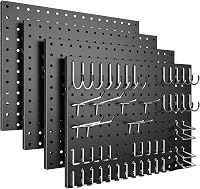
- Straight hooks suit tools with a hole or loop in the handle, and they slide into a new spot easily.
- Curved hooks cradle rounded handles, such as a hammer or a file.
- Angled hooks hold small tools and keep them from sliding off the end.
- Bins hold screws, nails and small hardware.
- Ring holders and racks keep several small tools together in one place.
Piece counts can mislead, because a big total includes small parts. INCLY's 278 pieces include 109 peg locks, and WEN's 114 include 47 peg locks.
Count the hooks that will hold your tools, then check the shapes against what you own. INCLY's mix includes 48 curved hooks (18 large, 14 medium and 16 small) and 45 L-shaped ones (25 medium and 20 small).
Do pegboard hooks fit every board?
No, hooks have to match the hole size and spacing of your board, or they sit loose and tip. Measure a hole's width and the gap from one hole to the next before you order.
INCLY fits 1/8 in pegboard with 1 in spacing, and it works in 1/4 in holes when you add its peg locks. ELEAD's set is made for 1/4 in boards, and WEN's kit fits 1/4 in or 1/8 in holes with 1 in spacing.
A peg lock clips onto the hook's peg so it stays in the hole when you lift a tool off. INCLY says its locks use a rubber clip that grips the hole for extra stability.
How much weight can a pegboard hook hold?
It depends on the kit, so read the maker's rating before you hang anything heavy. ELEAD rates each of its hooks for up to 70 lb, while INCLY gives its kit a 35 lb maximum weight capacity.
Buyers often mention that INCLY's hooks suit everyday hand tools better than very heavy ones. Those figures are ratings, not a promise for every tool, and a hook is only as steady as the board and mounting behind it.
Our how to attach pegboard to a workbench guide covers the mounting side. Keep the heaviest tools low and close to the bench, where a fall does the least damage.
How do you keep small parts from piling up?
Hang bins on the middle rows and sort screws, nails and small hardware by type. INCLY includes 12 bins and ELEAD includes 18, and both kinds hang on the board's hooks.
INCLY says its bins slide on and off the hooks, so you can carry one to the bench and hang it back up. The bins are plastic and best for small parts, so keep heavy items off them.
Label each bin with tape or a marker so you can read it from across the room. Wipe the board and bins now and then, since dust makes labels and outlines hard to read.
What belongs on a shelf or in a drawer instead?
Anything too heavy, too bulky or too sharp to hang safely belongs below the board. That includes corded power tools, battery packs and chargers, and loose drill bits.
A pegboard works best for hand tools that hang by a handle. For the rest, a drawer or cabinet keeps things tidy, and our garage workbench with drawers vs cabinets comparison helps you pick a style.
When should you trace outlines?
Trace outlines after the layout has held for about a week. The first setup is rarely the final one, and a traced outline locks in whatever spot you picked.
In the first few days you'll notice which tools you reach for and which you skip. Once the layout holds, trace each tool with a marker or a paint pen.
An empty outline shows at a glance what's missing, so outlines pay off most in the daily zone, where a gap costs you the most time.
Should you buy a bench with a pegboard built in?
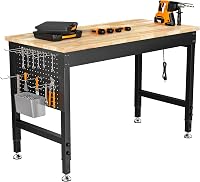
Yes, if you're setting up the bench and the board together, because it skips the wall-mounting step. CAMMOO's 48 x 24 in bench comes with a no-drill pegboard mounted on it, and CAMMOO says the board moves with the bench when you pull it away from the wall.
The bench also has a storage shelf, a power strip with 4 AC outlets and 2 USB-A ports, and an LED light fixed to the pegboard. Follow the maker's manual for the power strip, and ask a licensed electrician about the circuit you plug it into.
CAMMOO doesn't give the hole size of its pegboard, so check it against your hooks before you order accessories.
To compare benches with storage, see our best garage workbenches with storage roundup. For lights, the best garage workbenches with built-in lights roundup covers the options.
Pick a workbench pegboard organization plan you'll keep
Pick a hook kit if your bench and board are already up, and pick a bench with a board built in if you're starting from scratch. Either way, the layout matters more than the piece count, so start with your daily tools.
For the kits, choose by your holes: INCLY for 1/8 in boards with lots of small curved hooks, ELEAD for 1/4 in boards and heavier tools, and WEN for either hole size in a smaller set.
Keep the first layout loose for a week and move hooks until the bench feels right. The best workbenches with pegboard roundup compares more benches if you want to shop before you build.
Frequently asked questions
Where should a pegboard sit above a workbench?
Mount it on the wall above the bench, with the daily-use zone at eye level and within arm's reach of where you stand. Keep heavy tools on the lowest rows near the bench top, so you never lift them overhead, and leave the top row for tools you rarely use.
Should heavy tools go on the top row of a pegboard?
No, heavy tools belong on the lowest rows, close to the bench top, so you can lift them without reaching overhead. The top row works best for light tools you use only a few times a year, like a spare level or a combination square.
Do all pegboard hooks fit every board?
No, because hooks need the same hole size and spacing as your board. The INCLY kit fits 1/8 in pegboard with 1 in spacing and works in 1/4 in holes with its peg locks, while the ELEAD set is made for 1/4 in boards, so measure a few holes before you order.
How long should you wait before you trace outlines?
About a week: use the layout for a few days, note which tools you reach for and which you skip, then trace outlines only where the layout has settled. That way the outlines show how you really work instead of your first guess at the layout.