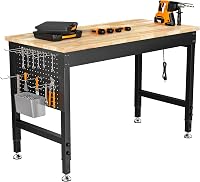
How to Level a Heavy Duty Workbench With Leg Levelers
Use heavy duty workbench leg levelers, or leveling casters, under each leg, then set a level on the top and adjust one corner at a time. Many garage floors slope toward the door or a drain by design, so a bench can rock even when it looks even.
On this page (11 sections)
- Why does a workbench rock on a sloped garage floor?
- Which heavy duty workbench leg levelers should you use?
- How do you match the thread and mounting holes?
- How do you measure how far to adjust?
- How to level a workbench in seven steps
- What comes in the box for each set?
- Can shims work as a stopgap?
- When do retractable casters make sense?
- Which foot material works on a garage floor?
- Do levelers change the bench's weight rating?
- Pick heavy duty workbench leg levelers for a bench that stays put
A bench that rocks on the garage floor is usually a floor problem, not a bench problem. Many garage floors slope toward the door or a drain, so one leg can sit higher than the rest.
Here's how to get the bench level, which heavy duty workbench leg levelers and casters suit the job, and what to check before you load it. Our garage workbenches buying guide covers bench heights and sizes, so this page covers the floor fix only.
We checked the specs for each product below, including thread sizes, what's in the box and what each one is built for.
Why does a workbench rock on a sloped garage floor?
A bench with four rigid legs rocks because a sloped or uneven slab lets it touch the floor at only three corners. The fix is a way to adjust the height of each leg, one corner at a time.
Check whether your bench already has adjustable feet before you buy anything. CAMMOO says its 48 in bench has adjustable metal feet for uneven ground, and its 60 in bench has glides that adjust through a 0 to 1.4 in range.
If your feet can't reach the gap, or the bench has none, add levelers or casters.
Which heavy duty workbench leg levelers should you use?
Use adjustable leveling feet for a bench that stays put, and leveling casters if you need to roll it now and then. Leveling feet give you a fixed base once they're set, while leveling casters add wheels so you can move the bench and set it back down.
POWERTEC's 8-pack attaches to each leg with screws, so it needs no matching thread. Its L-shaped ledge carries the load on the leveler rather than the screws, and its nylon pads suit hardwood, tile and concrete.
POWERTEC says the pads aren't ideal for soft wood or high-gloss floors. The set includes eight lock nuts, 32 screws and two 5 mm hex wrenches.
How do you match the thread and mounting holes?
Match the thread size to the threaded hole in your bench legs, and check the mounting hole size before you order casters. NEWBYTEK says its feet are true 3/8-16 and not made for metric M10, so measure first.
Measure the outer diameter of your bolt or hole with calipers if you can, since a ruler is less accurate. Then count the threads.
NEWBYTEK recommends its feet for wooden legs, and says legs should be more than 1-1/2 in across. For wood, it calls for a 1/2 in hole more than 2 in deep, and for metal legs it calls for welded inserts that it says non-professionals shouldn't attempt.
Heavy duty workbench leg levelers for a sloped floor
Check the adjustment range before you buy, since a steep slope needs more travel than a short leveler gives. NEWBYTEK's feet are 2.75 in tall and add 4/5 in to 2-1/4 in of adjustment.
Use your own numbers to check: if the gap between your highest and lowest corner is 1 in, you need more than 1 in of travel at the low corner. Levelers also raise the bench, so recheck your work height afterward with what height a garage workbench should be.
How do you measure how far to adjust?
Set a level on the top first, then measure from the floor to the underside of the frame at each corner with a ruler. Write down the four numbers and note the highest and lowest corners.
The gap between them tells you how far the levelers need to move, so you can turn each one with a plan rather than guessing. Take each reading at the same spot on each corner, so the numbers compare fairly.
How to level a workbench in seven steps
Set a level on the top, then adjust one corner at a time until the bubble centers in both directions. Unload the bench and get a helper before you tip or lift it to fit the levelers.
- Clear the bench top and the floor under each foot, so nothing blocks the levelers.
- Wind every leveler down to the same short length, so you start from an even baseline.
- Set a bubble level or a phone level on the top, first front to back, then side to side.
- Raise the low corners one at a time until the bubble centers, and recheck after each turn.
- Tighten the lock nut against the leg once the bench reads level, if your set has one.
- Load the bench with a normal load and check the level again, since the floor and the bench can settle.
- Recheck after a few weeks of use, and again if you ever move the bench.
Work slowly, because a small turn on a leveler can move the bench more than you expect.
What comes in the box for each set?
Check the hardware in the box before you start, since the sets differ a lot:
- HOLKIE: four leveling casters with no install hardware, so plan on M6 nuts and bolts for the 0.25 in holes.
- POWERTEC: eight levelers, eight lock nuts, 32 screws and two 5 mm hex wrenches.
- NEWBYTEK: four levelers, four round T-nuts, felt pads and screws.
- Ronlap: four mounting plates, four swivel casters, 24 mounting screws, four mounting nuts and two wrenches.
Ronlap advises pre-drilling pilot holes and tightening carefully, and says structural-grade screws, which aren't included, suit hardwood.
Can shims work as a stopgap?
Shims can steady a wobbly bench for a day, but they slip and crush, so swap them for adjustable levelers as soon as you can. Folded cardboard and wood shims are the usual quick fix.
Use them only until the levelers are in place, and check the bench again after the first load. A shim that holds today can shift when someone bumps the bench next week.
When do retractable casters make sense?
Retractable casters make sense for a bench you move often, because you step on the pedal to roll it and set it back down when it's in place. They don't level the bench, though, since the bench rests on its own legs once the wheels retract.
Ronlap's set lifts the bench 3/4 in off the floor with a foot pedal, and its 3 in urethane wheels swivel 360 degrees. Ronlap says these casters can't work on rough ground, so keep them for smooth floors.
HOLKIE's leveling casters combine wheels and height adjustment. HOLKIE says a ratchet handle adjusts the height, and that the base grips the ground to keep the equipment from moving.
If you want to roll a bench with drawers, see our best mobile workbenches with drawers roundup.
Which foot material works on a garage floor?
Nylon bases protect the floor and let the bench slide without scratching, but they suit some floors better than others. POWERTEC and NEWBYTEK both use nylon bases, HOLKIE's wheels are nylon and Ronlap's are urethane.
POWERTEC says its pads aren't ideal for soft wood or high-gloss flooring. NEWBYTEK says its 2 in nylon base holds up better than brittle plastic on rough concrete, and it adds optional felt pads for indoor hardwood.
Felt pads help on finished floors, but they don't change the level, so they're no fix for a sloped slab. If you want rubber feet, check your floor finish and the maker's guidance first.
Do levelers change the bench's weight rating?
No, levelers fix the level but don't make a bench stronger, so keep the load inside the bench maker's rating. The levelers have their own ratings too, and the lower of the two limits is the one that counts.
Ratings assume the weight is spread evenly and that the floor under each foot is solid. Read how much weight a workbench can hold before you load heavy tools, and follow the maker's manual for your bench.
Pick heavy duty workbench leg levelers for a bench that stays put
Pick heavy duty workbench leg levelers if the bench stays in one spot, and pick retractable or leveling casters if you move it often. Start with the levelers, then add casters only if you need to roll the bench.
Once the bench sits level, the surface matters next, so see garage workbench top material for the trade-offs. If you're shopping for a new bench, our best garage workbenches with storage roundup shows benches with drawers and cabinets.
Frequently asked questions
Why does a workbench rock on a garage floor?
Garage floors often slope toward the door or a drain, so one corner can sit higher than the rest. A bench with four rigid legs then rests on only three corners, so each leg needs a leveler or a caster you can adjust to set the top level.
Should I use leveling feet or leveling casters?
Use leveling feet for a bench that stays in one spot, since they give a firm base once set. Pick leveling casters if you need to roll the bench now and then, and check that the set you buy fits your leg mount and hole size.
What thread size do I need for workbench levelers?
It depends on which leveler you buy: NEWBYTEK's feet use 3/8-16 threads and aren't made for metric M10, so measure the outer diameter and count the threads before you buy. Some levelers, like POWERTEC's, attach with screws and need no thread match.
Can levelers make a workbench stronger?
No, because levelers fix the level but don't add strength to the bench. Keep the load within the bench maker's rating, spread heavy items across the top and follow the maker's manual, and check the rating before you add heavy tools, since a level bench still has a limit.