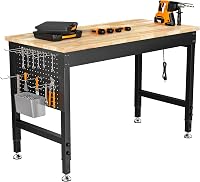
What Height Should a Garage Workbench Be?
For most people, a garage workbench height of 34 to 38 in, near elbow height, works well for hand tools. Go lower for heavy pushing work and higher for fine detail.
On this page (10 sections)
- What height should a garage workbench be for most people?
- How do you measure the right garage workbench height?
- How should the height change for each task?
- What height ranges do adjustable workbenches cover?
- Is a hand crank or an electric lift the better adjustment?
- When does a fixed-height garage workbench make sense?
- Does an uneven garage floor change the right height?
- What if you're much taller or shorter than average?
- Do a stool or mat change the right height?
- Which garage workbench height fits your work?
A garage workbench height that suits you usually puts the top near your elbow. At that level your back stays upright and your tools stay in easy reach.
Most people start in the 34 to 38 in range for hand tools, then adjust a few inches for the job in front of them. This guide shows how to measure your own number, how to change it for each task and which height ranges the benches we compared offer.
What height should a garage workbench be for most people?
A common starting point is a top about elbow height or a little below, roughly 34 to 38 in. Stand at the bench with your arms relaxed, and check that your hands rest on the top without lifting your shoulders.
A bench that is too low makes you bend, and one that is too high lifts your shoulders.
Garage workbench height for hand tools and general repairs
Screwdrivers, wrenches, small repairs and layout work all sit well near elbow height. You can see the work, and your back stays upright.
Sawing, planing and sanding ask for something different, which the task table below covers.
How do you measure the right garage workbench height?
Measure from the floor to your elbow with your arms relaxed and your elbows bent at 90 degrees. Use the steps below, in the shoes you normally work in.
- Stand on the floor where the bench will sit.
- Let your arms hang relaxed at your sides.
- Bend your elbows to 90 degrees, with your forearms pointing forward.
- Measure straight down from the bottom of your elbow to the floor, and write the number down.
Treat that number as your target, not a rule. Look for a bench whose range reaches a few inches above and below it, so you have room to adjust.
Say your elbow measures 38 in. A bench that adjusts from 28.5 to 39 in covers that number, with room to drop lower for seated work.
How should the height change for each task?
Hand tools, power tools, assembly and sitting work each ask for a slightly different height, so set the bench for the job you repeat most. The table gives a starting point measured against your elbow height.
| Task | Start here | Why |
|---|---|---|
| Wrenches, screwdrivers and small repairs | At elbow height or a little below | Your back stays upright and you can see the work |
| Sawing, planing, sanding and other pushing work | A few inches below elbow height | Your body weight does more of the work |
| Assembly, small parts and fine detail | A few inches above elbow height | You see small parts without bending your neck |
| Seated work on a stool | Forearms rest level on the top | Your stool changes the number, so measure with it |
Check a power tool's manual for its own setup guidance. The right height for a bench sander may not be the right height for a hand plane.
What height ranges do adjustable workbenches cover?
Most adjustable benches we compared start between 28 and 31.5 in and top out between 39 and 41 in, and only two go higher. Match the range to your elbow measurement and your stool, not to the biggest number on the page.
| Bench | Height range | How it adjusts |
|---|---|---|
| CAMMOO 48 in | 28.5 to 39 in | 6 settings, tool-free knobs |
| CAMMOO 60 in | 28.8 to 39 in | 6 settings |
| WORKPRO 60 in | 31.5 to 39.4 in | 5 settings |
| VEVOR 72 in | 28 to 39.5 in | 10 holes, no tools needed |
| Ultrawall 47.5 in | 29 to 41 in | 8 settings |
| WORKPRO crank bench | 28.7 to 47.2 in | Manual crank, any height in the range |
| FLEXISPOT electric | 28.1 to 45.7 in | Motor with 4 memory buttons |
The CAMMOO 48 in adjustable bench moves through six settings from 28.5 to 39 in, and its knobs turn by hand with no tools needed.
Is a hand crank or an electric lift the better adjustment?
A hand crank needs no power and tucks away, while an electric lift changes height with a button press. Choose by how often you change height and whether you want power at the bench at all.
Hand crank adjustment
The WORKPRO bench raises from 28.7 to 47.2 in with a manual crank, so it works without electricity, motors or a control panel. The crank tucks beneath the top when you're not using it, which keeps the work area clear.
WORKPRO rates it for 300 lb, so check that against your heaviest equipment.
Electric lift adjustment
The FLEXISPOT electric bench moves from 28.1 to 45.7 in, and its four memory buttons return you to a saved height quickly. It's also rated for 300 lb, well below the 2,000 lb on CAMMOO's adjustable benches.
The best electric adjustable height workbenches guide compares more electric options.
Electric models need power at the bench, so plan the spot first and follow the maker's manual for setup.
When does a fixed-height garage workbench make sense?
A fixed bench makes sense when you know your height, you use the bench for one kind of work and you measure before you order. It's the simplest style, with no motor or crank to adjust.
Some fixed benches state a top height. The IGERI bench has a 35 in working height, and the Eltean 55 in rolling bench is a fixed 37.5 in tall, so both sit inside the 34 to 38 in starting range.
The WEN WB4723T is a fixed-height bench with two drawers, upper and lower shelves, a pegboard, three outlets and an overhead light. It's 62 in tall overall, which is the whole bench and not the height of the top, so check the top's own height before you order.
Its enamel-coated top is rated for 220 lb, and that rating assumes the weight is spread evenly.
Measure your elbow height before you order, because a fixed bench does not change for you.
Does an uneven garage floor change the right height?
An uneven floor can leave a bench rocking or sitting lower on one side, so check the feet before you set the height. A bench that sits flat gives you a true reading of the height you chose.
The WORKPRO crank bench has adjustable leveling pads and widened T-shaped feet, which help it stay balanced on slightly uneven floors. The CAMMOO 60 in bench has glides that adjust by up to 1.4 in.
For a step-by-step method, read how to level a workbench on an uneven garage floor.
What if you're much taller or shorter than average?
If you're much taller or shorter than average, the range matters more than the middle number. Check the bottom and the top of the bench's range against your own measurement, not against an average.
If your elbow measures more than 41 in, only the WORKPRO crank bench and the FLEXISPOT go higher than the rest of the adjustable benches we compared. If it measures less than 34 in, a fixed bench at 35 to 37.5 in may sit high, and an adjustable bench that starts near 28 to 29 in leaves you more room.
If you share a bench with someone of a different height, look for a range that covers both of you. Memory buttons can store a height for each person.
Do a stool or mat change the right height?
A stool or anti-fatigue mat adds comfort, but it does not change the right bench height. Set the bench height first, then add a stool or mat if you still want more comfort.
If you have ongoing back, neck or shoulder pain, talk with a doctor before you change how you work.
Which garage workbench height fits your work?
The right garage workbench height is the one your elbow measurement and your tasks point to. Use these rules to choose:
- Pick a fixed bench if one height suits nearly all of your work and you know that number.
- Pick an adjustable bench if you switch between hand tools, power tools, assembly and sitting work.
- Pick a hand crank if you want no power at the bench, or an electric lift if you change height often.
Check the height again once the bench is fully assembled, because that final setup is the one you'll use every day. Measure your room with what size garage workbench do you need, then read how deep should a garage workbench be to size the top.
To decide between the two styles, read adjustable vs fixed height workbench. The garage workbenches buying guide covers the full picture.
Frequently asked questions
What height should a garage workbench be?
A common starting point is elbow height or a little below, about 34 to 38 in, where lower suits heavy pushing work and higher suits fine detail. Measure from the floor to your bent elbow, then choose a height range that covers that number with a few inches to spare.
How do you measure the right height for a workbench?
Stand on the floor you'll work on, let your arms relax, and bend your elbows to 90 degrees. Measure straight down from the bottom of your elbow to the floor, and that number is your starting height, which you can fine-tune once the bench is set up.
Is an adjustable garage workbench better than a fixed one?
An adjustable bench helps when you switch between hand tools, power tools, assembly and sitting work, but if you always work at one height, a fixed bench can be simpler. Check the lowest and highest settings against your measurement before you choose the style.
Can a stool or mat fix the wrong bench height?
No, a stool or anti-fatigue mat adds comfort but does not change the right bench height, so set the bench height first, then add a stool or mat if you still want more comfort. If you have ongoing back, neck or shoulder pain, talk with a doctor.