Garage Workbench Depth: How Deep Should It Be?
Most garage workbench depths fall between 20 and 30 in, and 24 in is a common middle. Go deeper only if you have the wall space and the tools that need it, and shallower if you need a walkway.
On this page (11 sections)
- What depth is most common for a garage workbench?
- Which garage workbench depth suits which work?
- How deep should a garage workbench be for hand tools and repairs?
- When does a deeper garage workbench make sense?
- Is more length a better fix than more depth?
- Does a folding or rolling bench change the depth math?
- How far can you reach across a garage workbench?
- How much walkway do you need beside a garage workbench?
- How do you read the depth in a bench's size?
- How do you test depth before you buy?
- Which garage workbench depth fits your garage?
Most garage workbenches are 20 to 30 in deep, and 24 in is the common middle. Depth is the distance from the back edge of the top to the front edge, and it decides how far you reach, how much floor the bench takes and whether a long tool fits on the top.
This guide explains the trade-offs of going deeper or shallower. A table matches each depth to the work it suits, using the benches we compared.
What depth is most common for a garage workbench?
A depth of about 24 in is the common middle, because it gives a usable top without taking over the floor. It's deep enough for most hand tools and small projects, and it usually leaves room for a walkway.
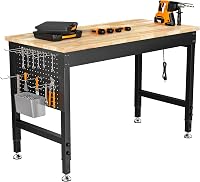
The CAMMOO 48x24 is 48 in long and 24 in deep, with a pegboard that moves with the bench and a metal shelf under the top.
Which garage workbench depth suits which work?
Tops of 20 to 22 in suit tight walls and lighter tools, 24 in suits hand tools and repairs, and 25 to 30 in suits bigger projects. The table sets each depth against the work it suits.
| Depth | Benches we compared | Best use | Watch-out |
|---|---|---|---|
| 19.7 in | Eltean 55 in rolling bench | A tight floor, with drawers and cabinets built in | Less top space for large work |
| 21.7 to 22 in | IGERI 39.4 in, CAMMOO 60 in, WORKPRO 60 in | Narrow walls, or a long top on a shallow depth | Tight for large projects |
| 23.5 to 24 in | CAMMOO 48x24, CAMMOO 48 in adjustable, Eltean 48 in, Ultrawall 47.5 in, WORKPRO crank bench | Hand tools, repairs and a pegboard overhead | Tight for two projects at once |
| 25 in | VEVOR 72 in, WEN WB4723T (25 in footprint) | Long runs along one wall | A little more floor than a 24 in top |
| 30 in | FLEXISPOT 48x30 | Sewing, crafts and larger projects | Harder to reach across, and more floor |
The depths come from the benches we compared, not from every bench on the market. For the height side of the bench, read what height should a garage workbench be.
How deep should a garage workbench be for hand tools and repairs?
For hand tools and small repairs, 20 to 24 in is usually deep enough to keep the things you use most in reach. A deeper top gives you more room, but the tools at the back take more reaching.
Storage works better on the wall or under the top than on extra depth. A pegboard above the bench holds tools in sight, so the top can stay clear for the job.
Narrow benches can still hold a lot. The Eltean 55 in rolling bench is 19.7 in deep with six drawers and two cabinet doors, and the IGERI bench is 21.7 in deep with a full steel drawer and an integrated pegboard.
When does a deeper garage workbench make sense?
A deeper bench, around 25 to 30 in, suits larger tools and projects that need room to spread out. It gives you more surface for layouts, clamping and bigger work.
A miter saw, a large sander or a 3D printer may need more room than a standard top offers, so check the tool's footprint against the top. Measure the tool with its stand or case, since that changes the room you need.
The FLEXISPOT electric bench is 30 in deep and 48 in wide, with embedded drawers for small items. It's rated for 300 lb, so the extra depth is room to work, not extra load.
Once a top gets large, the material matters more. Garage workbench top material explains how tops differ.
Is more length a better fix than more depth?
Often, yes: if you need more surface, add length along the wall before you add depth, because length uses wall space instead of walkway. Surface area shows why.
A 72 x 25 in top gives 1,800 square inches. A 48 x 30 in top gives 1,440, even though the FLEXISPOT is 5 in deeper than the VEVOR.
The VEVOR 72 in bench is 25 in deep and comes with universal wheels and rubber feet, so you can roll it or hold it still.
Does a folding or rolling bench change the depth math?
Yes, because a folding bench takes its full depth only while you use it. The Ultrawall wall-mounted folding bench takes less than 4 in of garage space when it's folded down, and the PONY folding table folds flat.
Plan the walkway for the open position, since that's when the bench is in your way. Check the open depth before you order, because it sets how much floor you give up during a project.
A rolling bench works the other way. Its depth stays the same, but you can park it against the wall and pull it out only when you need the floor space for a job.
How far can you reach across a garage workbench?
Keep the tools you use most within an easy arm's reach, close to the front edge. A deep top pushes the back row of tools out of reach, so grabbing them means stretching or leaning.
Test the reach with a tool in your hand, not an empty one, since that is how you'll really work.
A pegboard or shelf at the back brings those items into sight and within easy reach. For tools you grab often, the front and the sides of the bench are the best spots.
How much walkway do you need beside a garage workbench?
Leave a clear walkway you can use every day, and check that a car door can open fully before you pick a depth. Measure the real path, not the room on paper.
Pick the walkway width you're comfortable with, then add it to the bench depth. With a 36 in path, a 24 in deep bench needs 60 in of clear floor from the wall to the car, and a 30 in deep bench needs 66 in.
If your garage is very small, the garage workbench ideas for small garages guide shows layouts that save floor space. Our what size garage workbench do you need guide walks through the full footprint check.
How do you read the depth in a bench's size?
Confirm which number runs front to back, and check whether it covers the top or the whole footprint. Some size labels put the long side first, so a 48 x 24 in bench is 24 in deep.
The WEN WB4723T shows why the footprint matters. It has a 25 x 48 in footprint and a 47 x 23 in top, so the frame adds about 2 in of depth.
Garage workbench depth and the pegboard behind it
A pegboard puts tools above the bench, and the hooks and hung tools stick out over the back of the top. Plan the board's spacing before you hang anything, so the tools you use most are the ones within reach.
A pegboard that attaches to the bench can add to its footprint, so compare the top's depth with the footprint's depth. How to organize a pegboard above your workbench covers the layout for a wall board.
How do you test depth before you buy?
Tape the bench footprint on the floor before you buy, then check reach and the walkway in the real space. A few minutes with tape is far easier than moving a bench that does not fit.
- Mark the footprint on the floor, using the depth and length you're considering.
- Stand where you'll work and reach to the back row of the footprint.
- Walk past the footprint, and check that the path to the car and the door stays clear.
- Open the car door fully while the tape is down, and note any clash.
- Repeat the test with a second depth if you're between two sizes.
If the footprint passes every check, the depth is probably right for your garage. If it doesn't, you've learned that before the bench arrives.
Which garage workbench depth fits your garage?
The right depth depends on your walkway, your tools and the floor you have. Use these rules to choose:
- Pick 20 to 22 in if the walkway is tight and your tools are small.
- Pick 24 in if you want a common middle for hand tools and repairs.
- Pick 25 to 30 in if you work on larger projects and have floor space to spare.
Check the exact front-to-back size before you order, since a few inches change how the bench fits. Then compare the styles in the best garage workbenches with storage roundup, and read the garage workbenches buying guide for the full picture.
Frequently asked questions
How deep should a garage workbench be?
Most garage workbench depths fall between 20 and 30 in, and 24 in is a common middle. A deeper top gives more room but adds reach and takes more floor space, so measure your walkway first, then choose the depth that leaves room to move.
Is a 24 inch deep workbench enough?
For hand tools, small repairs and a pegboard on the wall, a 24 in deep bench is usually enough. Larger projects or a miter saw may need more room, so check the tool's footprint against the top before you buy and leave room to walk past the bench.
How deep is too deep for a garage workbench?
Past about 30 in, the back of the top gets hard to reach across, and the bench takes more of the floor. A deep bench also blocks more of the walkway, so if you need that depth, plan a clear path first.
Which number in a workbench size is the depth?
Depth runs from the back edge of the top to the front edge, and some size labels list the long side first, so a 48 x 24 in bench is usually 24 in deep. Check whether the number covers the top or the whole footprint, then add the walkway you need.